

What is the flexibility of welded steel belts?
Dec 30, 2025
Hey there! As a supplier of welded steel belts, I've been getting a lot of questions lately about the flexibility of these amazing products. So, I thought I'd take a moment to break it down and share some insights with you all.
First off, let's talk about what we mean by "flexibility" when it comes to welded steel belts. Flexibility in this context refers to the ability of the steel belt to bend, curve, and adapt to different shapes and applications without losing its structural integrity. It's a crucial characteristic that makes welded steel belts suitable for a wide range of industries and uses.
One of the key factors that contribute to the flexibility of welded steel belts is the material itself. High - quality steel alloys are carefully selected to ensure a good balance between strength and flexibility. These alloys are designed to withstand the stresses of bending and flexing without cracking or breaking. For example, stainless steel is a popular choice for welded steel belts because it offers excellent corrosion resistance along with good flexibility.
The manufacturing process also plays a significant role in determining the flexibility of the welded steel belt. At our company, we use advanced welding techniques to create seamless joints in the steel belts. This not only ensures a strong and reliable connection but also allows the belt to flex more easily. The precision of the manufacturing process helps to control the thickness and uniformity of the belt, which are important factors for flexibility. A thinner and more uniformly - made belt will generally be more flexible than a thicker or unevenly - manufactured one.
Now, let's look at some of the applications where the flexibility of welded steel belts really shines.
In the food processing industry, flexibility is essential. Welded steel belts are used in conveyors to transport food products through various stages of processing, such as baking, cooling, and packaging. The ability of the belt to bend around pulleys and curves allows for efficient and compact conveyor systems. For example, in a bakery, a flexible welded steel belt can smoothly move trays of bread through an oven and then around bends to the cooling area. This ensures that the food products are handled gently and uniformly, without any jolting or damage. You can check out our Wide Endless Steel Belts which are great for such large - scale food processing conveyor applications.
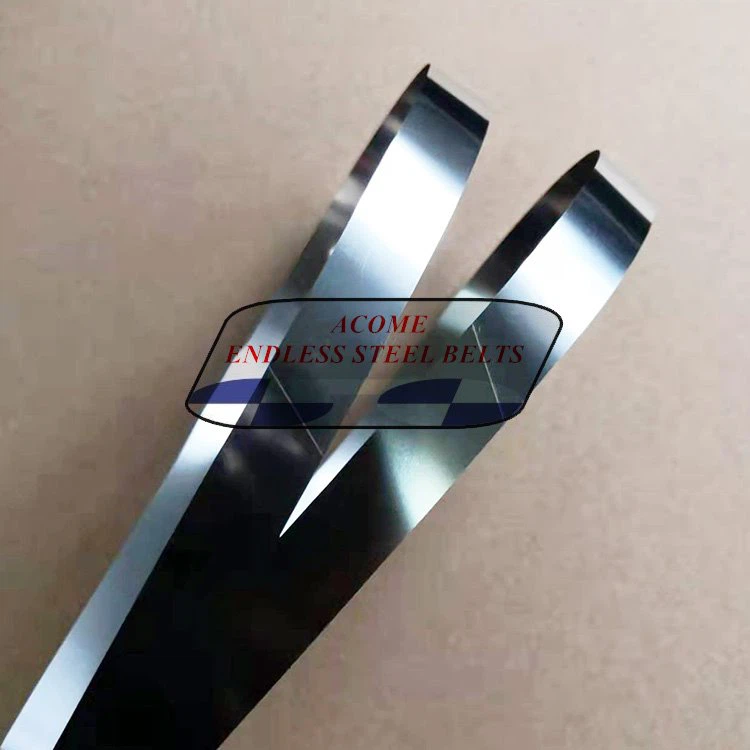

The printing industry also benefits greatly from the flexibility of welded steel belts. In offset printing presses, steel belts are used to transfer ink from the printing plates to the paper. The flexibility of the belts allows them to conform to the curved surfaces of the printing cylinders, ensuring a high - quality and consistent print. The ability to adapt to different shapes and sizes of printing equipment is a huge advantage, and our Precision Endless Steel Belts are specifically designed to meet these precision - printing needs.
In the automotive industry, welded steel belts are used in various applications, including timing belts and conveyor systems for manufacturing processes. The flexibility of these belts is crucial for ensuring smooth and efficient operation. For instance, a timing belt needs to be able to bend around the engine's pulleys and gears precisely to keep the engine's valves opening and closing at the right time. Our Ture Tracking Endless Steel Belts are designed with excellent tracking capabilities, which is important for the reliable operation in automotive conveyor applications.
Another important aspect of the flexibility of welded steel belts is their ability to handle different temperatures. In some applications, such as in heat - treating furnaces or cooling tunnels, the steel belts need to flex while being exposed to extreme temperatures. Our welded steel belts are made from materials that can withstand a wide range of temperatures, from very cold to extremely hot, without losing their flexibility or strength. This makes them suitable for a variety of industrial processes where temperature variations are common.
When considering the flexibility of welded steel belts, it's also important to think about maintenance. A flexible belt is generally easier to install and adjust. It can be more forgiving when it comes to aligning the conveyor system or other equipment it's used in. This can save both time and money in the long run, as there's less need for complex adjustments and repairs.
Now, I want to talk a little bit about how we test the flexibility of our welded steel belts. We have a series of in - house tests that we perform to ensure that each belt meets our high - quality standards. We use specialized equipment to bend and flex the belts at different angles and under various loads. This allows us to measure how well the belt responds to the stress and whether it retains its shape and strength. We also conduct long - term testing to see how the belt performs over time under continuous use.
If you're in the market for welded steel belts and you're looking for a product with excellent flexibility, we'd love to hear from you. Our team of experts is always ready to answer your questions and help you find the perfect belt for your specific application. Whether you're in the food processing, printing, automotive, or any other industry, we have the knowledge and experience to provide you with a high - quality and flexible welded steel belt solution.
So, don't hesitate to reach out and start a conversation with us. We're committed to providing the best products and service to our customers. Let's work together to find the right welded steel belt for your needs and make your operations more efficient and successful.
References:
- Metallurgy textbooks on steel alloys and their properties
- Industry reports on the use of welded steel belts in various sectors